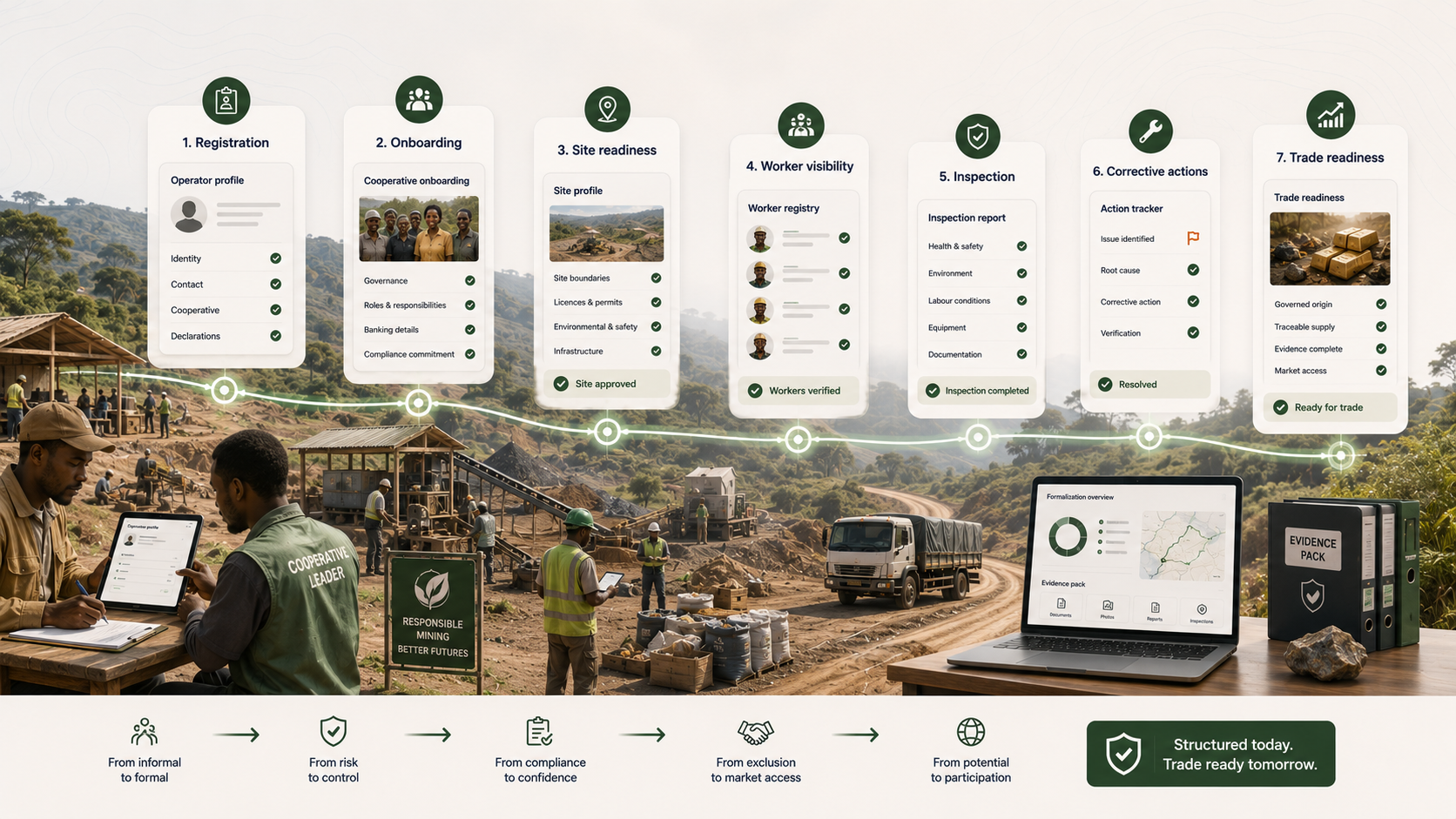
Formalization is usually described as a certificate, a status an artisanal or small-scale operation is granted once and then holds. That framing is why so much formalization effort produces documents but not durable participation. A certificate marks a moment. Credible, commercially usable supply requires a pathway.
Formalization first means treating the formalization of artisanal and small-scale mining not as a gate to pass but as structured progression: operators and cooperatives onboarded, sites brought to readiness, workers made visible, controls and evidence accumulated over time. Done this way, formalization is not a social-impact add-on. It is the commercial infrastructure on which everything downstream depends.
Formalization is participation, not a permit
The question a buyer or financier ultimately asks about an ASM operation is not whether it holds a certificate. It is whether it is a governed, legible participant in a supply chain, a known entity, with a known site, verifiable workers, and a record that can be reviewed. A permit does not answer that. Structured participation does.
Framing formalization as participation also changes who it serves. A one-time certificate mainly serves the issuer's records. A progression pathway serves the operator, by building the evidence that eventually lets them access serious buyers and capital on their own merits.
A certificate records that an operator was formal on one day. A pathway builds the evidence that they are a participant every day.
The pathway, step by step
Registration and onboarding
The pathway begins by turning anonymous inputs into known entities. Operators and cooperatives are registered and onboarded, so that everything captured later attaches to an identity rather than to a coordinate or a name on a delivery.
Site readiness
A registered operator is not yet a governed origin. Site readiness brings the place of production into the system: approvals, conditions, and the controls that make an origin something a reviewer can stand behind rather than a point on a map.
Worker visibility
Formalization that ignores workers is not formalization. Worker visibility makes labour and safety controls observable rather than asserted, which is both a governance requirement and, increasingly, a responsible-sourcing one.
Inspections and corrective actions
Progression is real only if it can move backward as well as forward. Inspections surface issues; corrective actions resolve them; both are captured against the operator and site. Readiness that cannot be lost and regained is not readiness, it is a label.
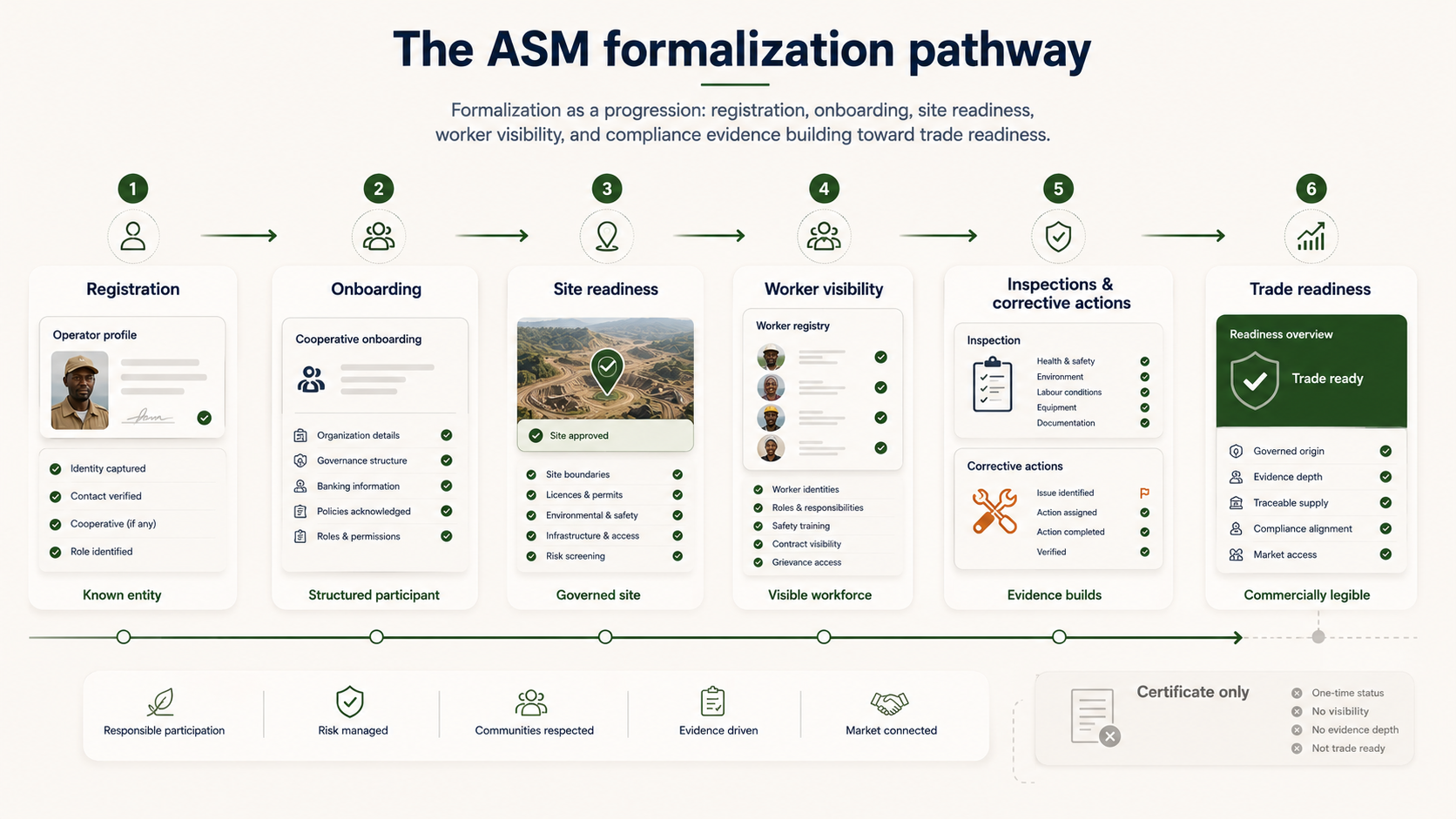
Figure 1. Formalization as a progression: registration, onboarding, site readiness, worker visibility, and compliance evidence building toward trade readiness.
Why this is commercial infrastructure
It is easy to file formalization under social impact and stop there. That undersells it. Every downstream capability an ecosystem wants, usable provenance, corridor readiness, a defensible bankability signal, assumes governed origin. Governed origin, for ASM, is exactly what a formalization pathway produces. Without it, the rest is built on sand.
- Provenance needs operators that are known and sites that are approved, the pathway supplies both.
- Compliance evidence needs an accountable entity to attach to, onboarding creates it.
- Bankability needs governed reality to read, progression is what accumulates it.
Axalio's role, and its limits
Axalio provides the structure the pathway runs on: onboarding, readiness, worker visibility, inspections, and the evidence they generate, coordinated in one system of record. The formalization itself, the legal recognition, the licensing decisions, the inspections' authority, remains with the operators, cooperatives, regulators, and assurance providers who hold it. Axalio orchestrates the pathway and makes its evidence usable. It does not confer formal status.
Axalio structures formalization pathways and their evidence. It does not confer legal or formal status, replace regulators or inspectors, or guarantee licensing, buyer acceptance, or export approval.