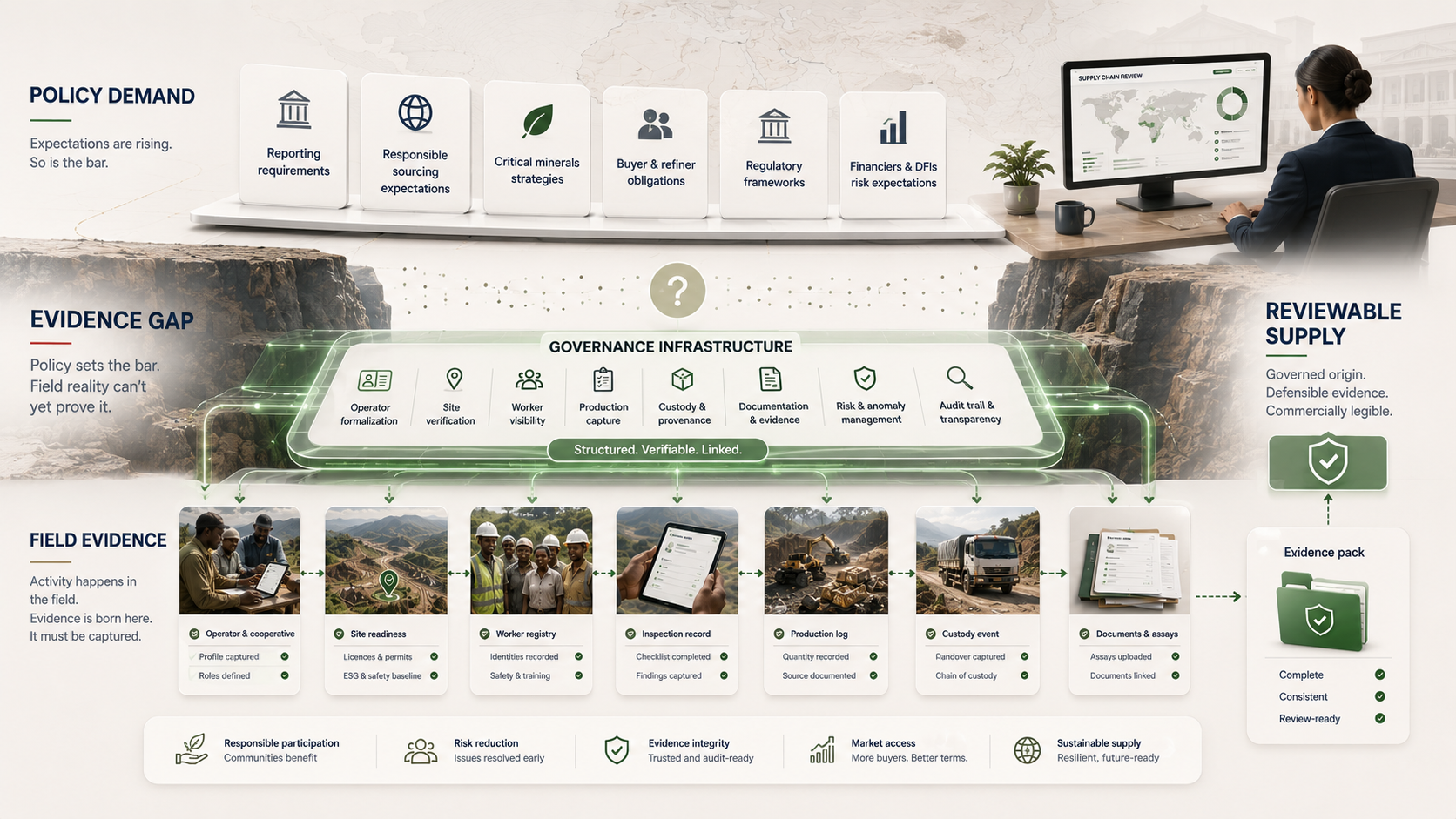
Read the policy landscape around minerals and a clear signal emerges. Reporting demands are expanding, critical-minerals strategies are hardening into procurement conditions, and responsible-sourcing expectations are converging across buyers, governments, and financiers. The direction is not in doubt. What is missing is rarely ambition. It is the infrastructure that lets any of it be evidenced.
This is the gap worth naming precisely. Policy creates pressure, obligations, expectations, deadlines. It does not create the operating capability to meet them. A reporting requirement does not produce the field evidence it asks for. A responsible-sourcing expectation does not formalize an operator. The demand is real and rising; the means to satisfy it, in most ecosystems, is still absent.
The pressure is converging
The forces are arriving from several directions at once, and they point the same way. Buyers and refiners are held to responsible-sourcing standards they must be able to demonstrate. Governments are treating certain minerals as strategic and attaching conditions to how they are produced and traded. Financiers are formalizing environmental, social, and governance expectations into diligence. Each raises the evidentiary bar for supply.
Individually, any one of these could be treated as a reporting task. Together, they describe a structural shift: governed, evidenced supply is becoming the condition of participation, not a differentiator within it.
Policy sets the requirement. It does not build the operating system that produces the evidence the requirement assumes.
Policy creates demand, not operating infrastructure
A regulation can require that supply be responsibly sourced and reportable. It cannot, by itself, capture an inspection at a site, formalize a cooperative, or link a production log to a custody record. Those are operating capabilities. When they are missing, the requirement lands on ecosystems that have no way to meet it, and the result is either non-participation or documentation that cannot withstand review.
This is why so much responsible-sourcing effort produces paperwork rather than confidence. The paperwork is an attempt to satisfy a demand for evidence that the underlying operation was never structured to generate. The honest fix is upstream: capture the evidence where the work happens, so the report is a read-out of governed reality rather than a reconstruction.
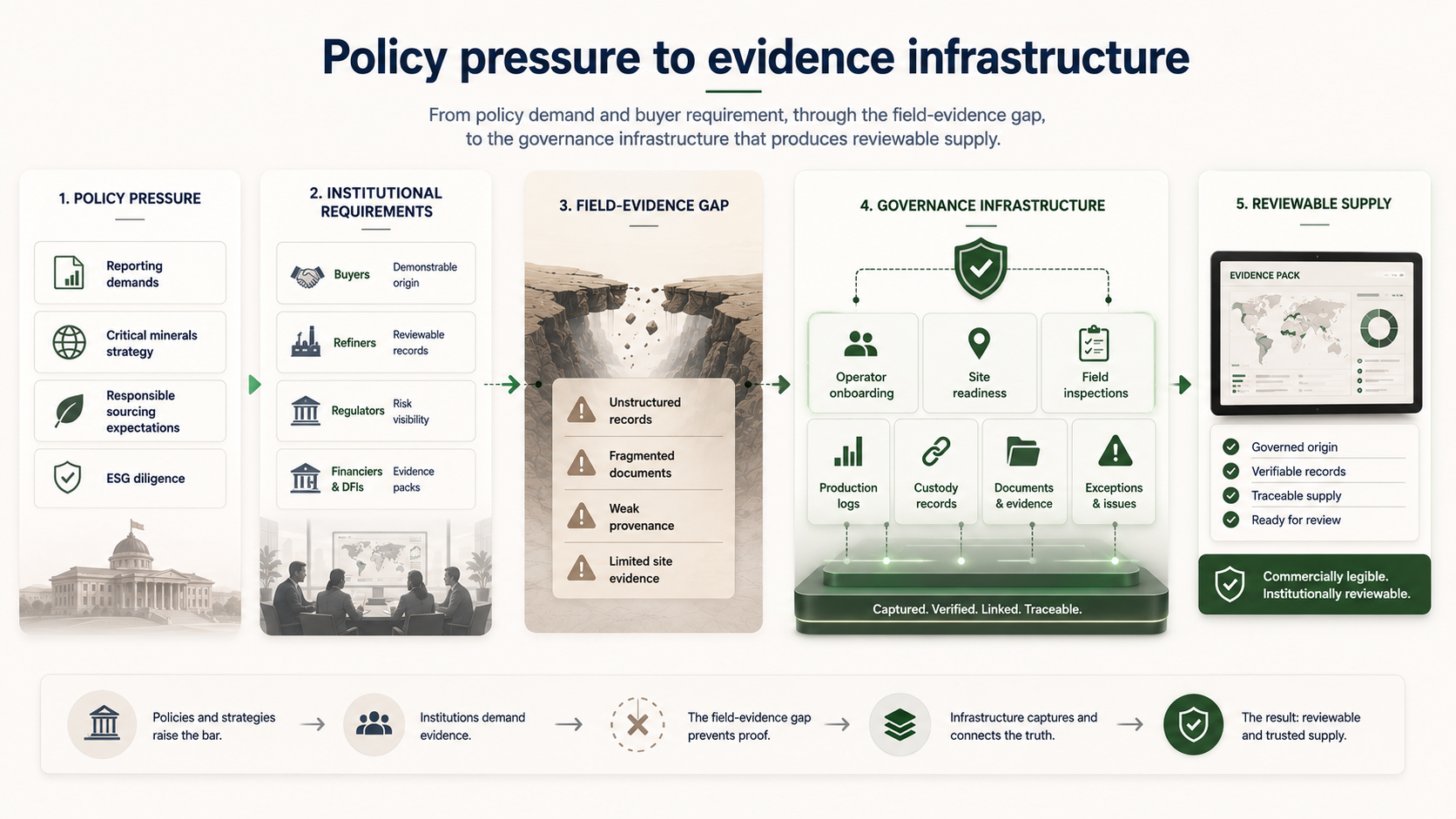
Figure 1. From policy demand and buyer requirement, through the field-evidence gap, to the governance infrastructure that produces reviewable supply.
Why field evidence, provenance, and governance records matter
If the gap is evidence, the answer is an infrastructure that produces evidence as a by-product of operating, the same governance-first stack that makes supply bankable also makes it reportable. Field-level compliance captured at source, provenance assembled from production logs and custody, and governance records tied to formalized operators and approved sites are exactly what a reporting obligation or a responsible-sourcing standard is reaching for.
- Reporting obligations need structured records, governance-first capture produces them.
- Responsible-sourcing standards need reviewable evidence, usable provenance provides it.
- Critical-minerals conditions need legible origin, formalization and governance supply it.
Axalio as the infrastructure layer
Axalio's role in this landscape is specific and bounded. It is the infrastructure layer that makes governed supply legible to institutions, the system of record and coordination layer that captures, structures, verifies, and surfaces the evidence policy is implicitly demanding. It does not set policy, interpret law, or certify compliance with any regime. It makes the evidence usable so that the institutions who do those things can act on something real.
That distinction is not modesty; it is accuracy. Regulators regulate, auditors audit, assurance providers assure. What has been missing is the operating infrastructure between the policy signal and the field, the layer that turns rising expectations into reviewable supply. That is the gap Axalio is built to close.
This analysis is not legal or regulatory advice. Axalio provides infrastructure that makes governed supply legible; it does not interpret law, set policy, certify regulatory compliance, or guarantee that any requirement is met.